
Scots, Scots-Irish, Scotch-Irish, Ulster-Scots
What’s in a Name?
The Scots-Irish, Scotch-Irish, and Ulster-Scots are variant names for the same people. All three relate to people who left Scotland, mostly in the seventeen (1600s) and eighteenth (1700s) centuries; settled via various, successive waves of the Ulster Plantation (Northern Ireland)—the northern-most province of Ireland; they stayed one, two, or three generations, and then moved to North America. That is the story of the Wilson-Thompson Families. The Scots however came to America directly from Scotland. They differ from others in that they did not spend any time in Ulster (Northern Ireland).
From the first decades of the eighteenth century, the Ulster-Scots emigrated to the Americas in ever increasing numbers. The migrant flow became stronger as settlers from N/Ireland took advantage of the opportunities in the burgeoning colonies. Having moved once already (from Scotland to N/I) and having broken the link with their ancestral home, it was quite practical to move again to where a better future beckoned. These early settlers established roots in the Philadelphia area, later many moved into western Pennsylvania, and south into the Shenandoah Valley, into Virginia, and into the Carolinas.
Although the terms, historically, have been used interchangeably in the Americas, the most common term is Scots-Irish. Linguists recommend against the term Scotch-Irish as `Scotch’ is a whisky, not a group of people. The term Ulster- Scots was more commonly used during our country’s Colonial Period. Regardless of the term used to describe, Americans of Scottish descent are fiercely proud of their heritage and title.
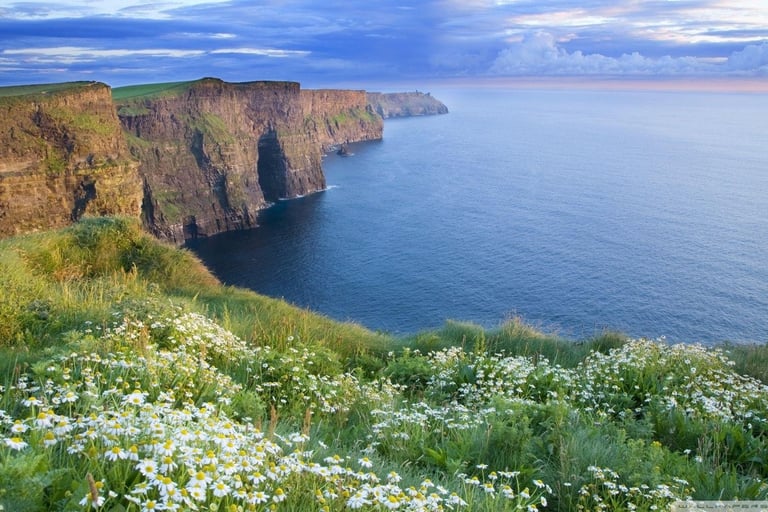
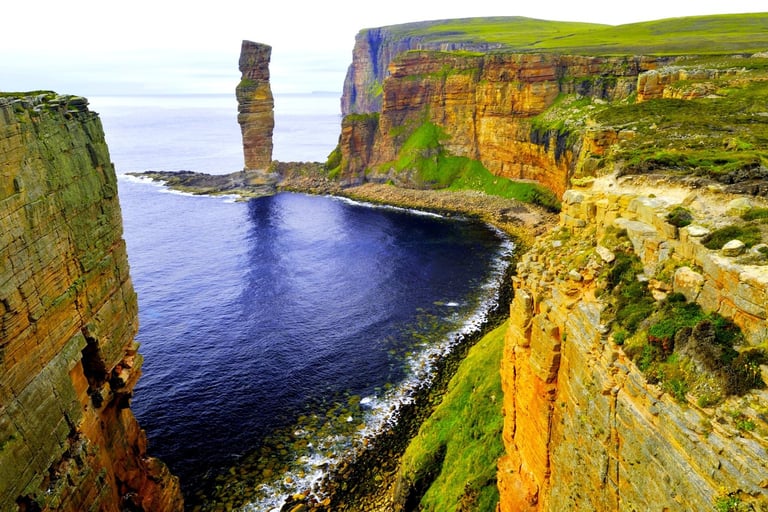
Old Man of Hoy, Scotland
Cliffs of Mohr, Ireland
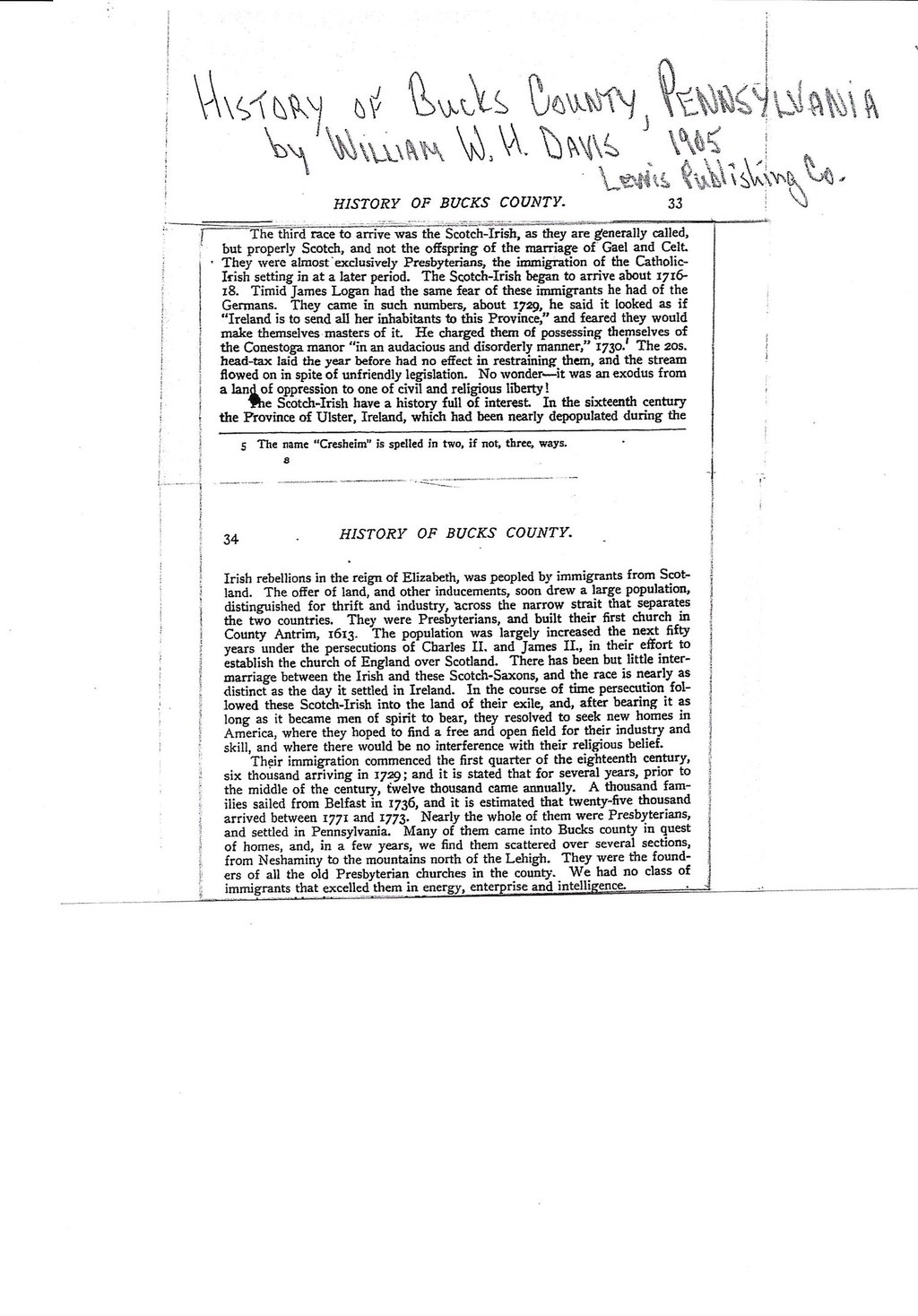
But What Were They Like? Here's a Bit More
_________________________________________________________
An Additional Observation
In 1895 historian Samuel Sweet Green delivered a report to the semi-annual meeting of the Council of the American Antiquarian Society (AAS), a prestigious body which houses historical documents, books, and artifacts in Boston. Here are some of his observations about the Scots-Irish and their emigration to America during the same time period the Wilsons, Thompsons, and McGraudy's emigrated:
"While considerable numbers of the Scotch-Irish emigrated to New England in the great exodus from Ireland during the fifty or sixty years prior to the American Revolution, the great body of those coming here entered the continent by way of Philadelphia. Penn's Colony was more hospitable to immigrants of faiths differing from the prevalent belief of inhabitants, than were most of the New England provinces (page 16-17).
Then, too, the Scotch-Irish emigrants were mostly farmers, and did not find New England so favorable from an agricultural point of view as some of the middle and southern colonies (page 17).
Immigrants came in such numbers to Philadelphia as to frighten James Logan, the Scotch-Irish Quaker Governor of Pennsylvania from 1699-1749. He complained in 1725 that `it looks as if Ireland were to send all her inhabitants hither; if they will continue to come, they will make themselves proprietors of the province' (page 17).
Several Scotchmen and Scotch-Irishmen signed the Declaration (of Independence). Professor Macloskie of Princeton College (now University) states that the 'Declaration of Independence as we have it today is in the handwriting of a Scotch-Irishman, Charles Thomson, the Secretary of Congress; was first printed by Captain Thomas Dunlap, another Scotch-Irishman, who published the first newspaper in American; a third Scotch-Irishman, Captain John Nixon, of Philadelphia first read it to the people (page 24).
The Scotch-Irish emigrants to his country were generally speaking, men of splendid bodies and perfect digestion. They were men, too, of marked mental characteristics, which have impressed themselves on their posterity. They were plain, industrious and frugal in their lives. It has been said, such was their thrift, that Poor Richard himself could have given them "no lessons against wastefulness and prodigality (page 36).
But they had good intellectual powers and strong wills. They were noble for practical sagacity and common sense, and for tenacity of purpose. Conscious of their merits they were self-reliant and always ready to assert themselves, to defend their own rights and those of their neighbors and courageously push forward. Plain in speech, they were not infrequently frank to the point of rudeness. With energy and firmness, while often hard, they were affectionate toward persons who conciliated them, hospitable and faithful. Their sedateness was qualified by their wit and humour (page 36-37).
The Scotch-Irish were led to come to this country, not only by the desire to better their material condition and to escape persecution, but by a desire of daring (page 37).
As we have seen they took up their abode on our frontiers and defended us from the depredations of Indians and did a large portion of the fighting required in our wars. They were ardent promoters of civil and religious liberty. As was to be expected, these Scotch Calvinists breathed the spirit of John Knox and contended fervently that the final regulation of political action belongs to the people (page 37).
The Scotch-Irish, however, were never content with a sentimental piety, but sought always with tremendous earnestness, to place religion on a basis of knowledge and thought. They were...of high moral principle and marked integrity. Another characteristic which never failed to appear among settlements of this people, was a mighty zeal for education. They were never content with the lower grades of common schools, but demanded, everywhere, classical high schools, and later, colleges and universities (page 37).
Why Are They Called Scotch-Irish in America but Ulster Scots in Ireland?
By Bagtown Clans
from The Story of Ulster Scots
Aug 28, 2025
“When you search for your ancestors in records, when you attend a heritage festival, or when you leaf through a history book, you may find two names used almost interchangeably: Scotch-Irish and Ulster Scots. They describe the same people, yet each term carries with it centuries of history, politics, and identity. Untangling the names is not simply a matter of semantics — it is a window into the story of a people who left Scotland, settled in Ulster, and then crossed the Atlantic to shape America.
That is the story we explore in our new book, The Story of the Ulster Scots: Across Time, Across Oceans, Across Nations, now available on Amazon. But let’s step back and look at why the same community carries two different names, and how those names reveal their journey across time and space.
Scots in Ulster
The first stage of the story begins in the early seventeenth century. After the Flight of the Earls in 1607, the English Crown confiscated huge tracts of land in the north of Ireland. To secure the province and prevent further rebellion, James VI and I launched the Plantation of Ulster. Land was granted to undertakers, servitors, and loyalists — but the actual settlers came largely from western Scotland, where the North Channel could be crossed in a day.
These were not Highlanders in tartan plaid, but Lowland farmers, artisans, and ministers from Ayrshire, Galloway, and Renfrewshire. They spoke Scots, a language closely related to English, and they brought with them Presbyterian faith, literacy, and a culture of hard work. To their neighbors in Ireland, they were simply the Scots who had settled in Ulster — hence, Ulster Scots.
The name was straightforward, describing both origin and destination. In the seventeenth century, it was a geographic and ethnic label: Scots in Ulster, distinct from the English planters and the native Irish.
The Hyphen and the Culture
Over time, the term often appeared as Ulster-Scots, with a hyphen. This form stressed dual identity — Scottish in heritage, Ulster in residence. The hyphen signified that the people had become something new: not just Scots abroad, but a community that had taken root in Ulster soil, shaped by the land, the Kirk, and the conflicts of their adopted home.
Today, cultural institutions like the Ulster-Scots Agency often use the hyphenated form to highlight language, arts, and living traditions. To speak of Ulster-Scots in this sense is to emphasize culture, dialect, and heritage within Northern Ireland itself.
But when these same people crossed the Atlantic in the eighteenth century, another name awaited them.
“Scotch-Irish” in America
When tens of thousands of Ulster Scots emigrated to the American colonies between 1717 and 1775, they were labeled in a new way. In the English of the eighteenth century, the common adjective for things Scottish was Scotch — Scotch merchants, Scotch soldiers, Scotch cattle. And since these settlers came last from Ireland, they were called Scotch-Irish.
The name caught on quickly in America, distinguishing them from Catholic Irish immigrants who would arrive later in greater numbers. The “Scotch-Irish” were Protestants, English-speaking, and often at the edge of the frontier. They gained a reputation as hardy pioneers who built cabins in the Appalachians, defended settlements with muskets, and contributed disproportionately to the Revolution.
By the nineteenth century, “Scotch-Irish” had become the dominant term in American memory and genealogy. Descendants embraced it proudly, celebrating their ancestors as tough, independent, and liberty-loving.
Same People, Two Perspectives
So are the Scotch-Irish and the Ulster Scots two different peoples? Not at all. They are the same community, viewed from different vantage points.
• In Ireland and Britain, the term Ulster Scots emphasizes their origin and place in Ulster’s history.
• In America, the term Scotch-Irish highlights their role as emigrants from Ireland of Scottish descent.
The choice of name is often about context. In genealogical research, “Scotch-Irish” is most common in American records, while “Ulster Scots” appears in Irish and Scottish sources. Modern scholars tend to use both, depending on whether they are writing about the story in Ireland or in the diaspora.
Identity in the Present
Today, the dual names still carry meaning. In Northern Ireland, Ulster-Scots is associated with language, music, and cultural revival. Ullans, the dialect of Scots spoken in Ulster, is taught in schools, featured on radio, and celebrated in festivals. Fiddling, pipe bands, and storytelling keep the heritage alive.
In America, Scotch-Irish societies and heritage groups flourish, linking descendants with their ancestors’ world. From Appalachia to Pennsylvania, festivals, genealogical societies, and historical markers keep alive the memory of the people who carried Presbyterianism and resilience into the backcountry.
Why the Names Matter
The two terms — Ulster Scots and Scotch-Irish — are not just labels. They are reminders of journeys. They tell us that these people were migrants twice over: first from Scotland to Ulster, and then from Ulster to America. They remind us that identity shifts with geography and history, that a community can be both Ulster and Scotch-Irish, both rooted and restless.
For those researching family history, the names matter because they guide you to the right sources. Look for Ulster Scots in parish registers, plantation records, or townland maps. Look for Scotch-Irish in ship passenger lists, colonial land grants, or Revolutionary muster rolls. Together, the two names open windows into a four-hundred-year saga.
The Story in Full
In the end, whether you call them Ulster Scots or Scotch-Irish, you are speaking of the same remarkable people. They endured famine and persecution, they signed covenants and fought battles, they carried flax and psalm books, they built cabins and log churches, they wove linen and wove communities. They were Scots who settled in Ulster, Ulstermen who crossed the Atlantic, and Americans who helped forge a new republic.
That is why I chose to tell their full story in my book The Ulster Scots. It begins with the plantation, follows them through rebellion and war, traces their great migration to America, and carries the narrative all the way to today’s cultural renewal. The names may differ, but the people remain the same: resilient, faithful, and enduring.
So the next time you encounter the terms Scotch-Irish or Ulster Scots, remember that you are looking at two sides of the same coin. One name looks back to the townlands of Antrim and Down; the other looks westward to the Appalachian frontier. Together, they remind us of a people whose spirit carried them across centuries and continents — a people whose story still matters today.” (The Story of Ulster Scots: Across Time, Across Oceans, Across Nations by Bagtown Clans, 2025)
W-T Family: Why Are They Called Scots word file